
Over the years, I have served many families and walked with them through moments of loss. One reality I have observed is this: most people are not unable to arrange funeral matters — they simply have never fully understood the entire process.
Perhaps due to cultural sensitivities, this topic is rarely discussed, especially within the Chinese community. Many tend to avoid it, and as a result, there is little opportunity to learn or prepare in advance.
However, when the situation arises, decisions often need to be made within a very short period of time. Families are dealing with emotional stress while facing urgent arrangements. Without clear guidance, it can quickly become overwhelming.
In this article, I will present a structured overview to help you understand the complete process of Chinese funeral arrangements in Malaysia. By learning this in advance, you will at least have a clear timeline in mind when the time comes.
(Save and share this guide if you find it helpful.)
Part 1: What to Do Immediately After a Loved One Passes Away?
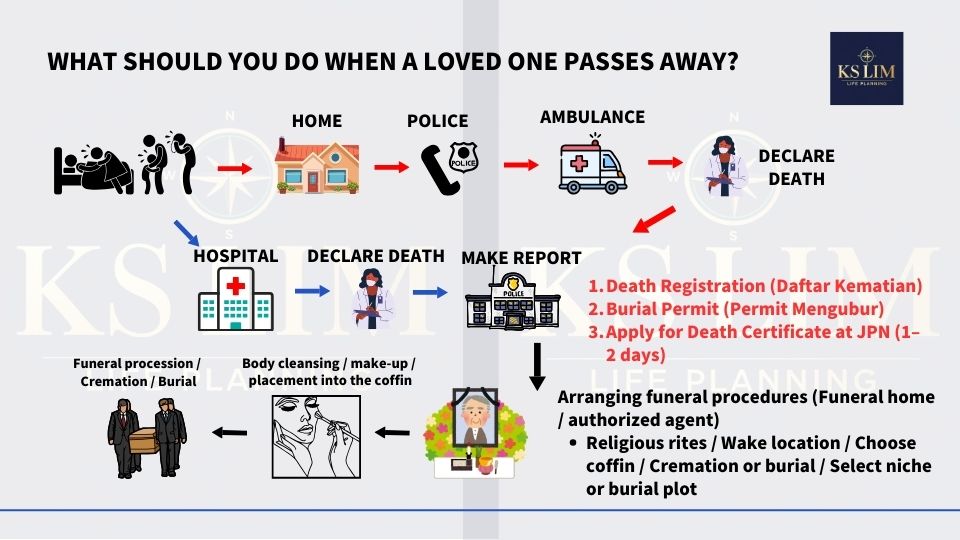
1. Obtain the Death Certificate (First and Most Important Step)
The death certificate is required before any funeral arrangements can proceed. Ensure it is issued by the relevant medical authority or hospital.
- Passing at a Hospital – The death certificate will be issued and signed by the attending doctor.
- Passing at Home – A doctor must be called to the location to verify the passing and issue the necessary documentation.
- Non-Natural Cause – Cases involving non-natural causes require police involvement and further procedures by the relevant authorities, including a post-mortem if necessary.
The death certificate is a fundamental document required for all subsequent funeral arrangements. It is advisable to prepare multiple copies for future use.
2. Contact a Funeral Service Provider
Reach out to a trusted funeral service provider to begin coordinating the necessary arrangements and receive guidance on the next steps.
- Transfer of the Deceased (to Home or Funeral Parlour) – Arrangements for the respectful transfer of the deceased to the home or designated funeral venue.
- Cleansing and Preparation – Careful cleaning and preparation of the body according to appropriate practices.
- Makeup and Dressing – Preparation of the deceased with proper attire and presentation.
- Wake Setup Arrangements – Setting up the wake area for family and friends to pay their respects.
- Venue Planning Assistance – Support in organizing and arranging the layout of the funeral or wake venue.
The purpose of this step is to allow the family to step away from technical arrangements and focus their time on being with their loved ones.
3. Assign Basic Roles Within the Family
Distribute simple responsibilities among family members to ensure tasks are handled smoothly during this period.
- Assign One Person for External Coordination (Funeral Service Liaison)
A designated family member communicates with the funeral service team to ensure smooth coordination.
- Assign One Person to Inform Relatives and Friends
Responsible for notifying others through phone calls, WhatsApp, Facebook announcements, or other communication channels.
- Assign One Person to Handle Documentation
Organize and prepare necessary documents such as identification copies, death certificate, cremation permit, body handling permit, and a photo of the deceased.
- Assign One Person to Manage Condolence Contributions
Keep proper records of contributions and ensure the condolence collection box is managed carefully.
When each family member has a clear role, the overall process becomes more organized and avoids unnecessary confusion.
4. Confirm the Deceased’s Wishes
If any prior preferences or arrangements were made, review and confirm them to guide the planning process.
- Will the arrangement be cremation or burial?
- Will the wake be held at home or at a funeral parlour?
- What type of religious ceremony will be conducted (Buddhist, Taoist, or others)?
These decisions may seem simple, but they are important. Families who have discussed them in advance often experience fewer disagreements and smoother arrangements during critical moments.
Part 2 : Complete Structure of Chinese Funeral Process in Malaysia

1. Pre-Funeral Arrangements (Administrative Stage)
- Obtain the official death certificate
- Contact a funeral service provider
- Arrange the wake location (home, funeral parlour, memorial hall, etc.)
- Notify relatives and friends
2. Wake and Vigil Period (Usually 3–5 Days)
- Set up the altar and wake hall
- Display the portrait of the deceased
- Prepare offerings
- Arrange monks or Taoist priests (if required)
- Conduct chanting or prayer ceremonies
The duration and rituals may vary depending on the family’s religion and customs. These arrangements can be coordinated directly with the funeral service team. Costs may differ depending on the provider.
3. Coffin Closing and Funeral Ceremony
- Final viewing by family members
- Coffin sealing ceremony
- Final farewell
- Funeral procession
Cremation Process:
- Transport to the crematorium
- Cremation ceremony
- Collect ashes after the designated period
- Place ashes in a columbarium or memorial niche
Burial Process:
- Transport to the cemetery
- Burial ceremony
- Interment process
4. Post-Funeral Memorial Traditions
Common traditional Chinese remembrance days include:
- 7th day (First Week), 21st day, 35th day, 49th day
- 100th day
- First anniversary
- Third anniversary
- Ancestor tablet merging ceremony
- Birth anniversary
- Death anniversary
- Qingming Festival
- Hungry Ghost Festival
- Mid-Autumn Festival
- Dragon Boat Festival
These rituals symbolize emotional continuity, remembrance, and respect for ancestors.
Part 3 : 3 Common Reasons Funerals Become Chaotic
1. Not Knowing Who to Contact First
It is recommended to assign only one main point of contact to avoid confusion and miscommunication.
If possible, families may consider pre-planning arrangements with a funeral service provider or memorial advisor. In the event of a situation, a single phone call to the assigned representative will allow them to handle the entire process, helping the family remain calm and focused.
2. Important Documents Are Difficult to Locate
Commonly misplaced documents include:
- Identification documents
- Medical records
- Written instructions or wills
It is advisable to store all important documents in one secure and accessible location.
3. Family Disagreements during Bereavement
Conflicts may arise due to differences in opinions regarding:
- Duration of the funeral rituals
- Location of the ceremony
- Religious practices
- Sharing of expenses
Clear financial planning and early communication can help reduce misunderstandings and tension.
Part 4 : What Can Be Done When There Is No Immediate Emergency?
1. Understand the Basic Process
Having a general understanding of the funeral process helps reduce anxiety when facing unexpected situations.
2. Communicate Basic Preferences with Family
Take time to discuss general preferences with family members. It does not need to be detailed, but understanding each other’s views can help future arrangements.
3. Organize Important Documents
Keep together:
- Identification cards
- Medical documents
- Insurance policies
Inform family members where these documents are stored.
4. Record Important Contacts
Examples include:
- Funeral consultant
- Family lawyer
- Insurance agent
- Estate planning advisor
Why Funeral Pre-Planning Matters ?
During emotionally vulnerable moments, what families truly need is:
- A peaceful farewell
- Time to accompany their loved one
- Clarity on what to do next
Not uncertainty about procedures or decisions.
A clear structure provides more stability than any reassurance alone.
I have witnessed families who were prepared. Although they were grieving, the process was organized and calm. I have also seen families who had no prior understanding, making rushed decisions under pressure, later feeling regret.
Preparation does not mean immediate action. It simply means giving your future self and your family more clarity and comfort.
While we cannot control when events happen, we can choose whether to leave behind a clear direction for our loved ones.
If you would like to understand the process in more detail, or simply learn how to start such conversations with your family, you may seek guidance first, understand the structure, and then decide at your own pace. True peace of mind often comes from having clarity before it is urgently needed.
Frequently Asked Questions (FAQ)
Q1. How many days does it usually take from passing to the funeral?
Typically, it lasts 3–5 days, and in rare cases up to 7 days. It mainly depends on:
- Family arrangements
- The seniority of the deceased
- Local customs
Q2. Can funeral arrangements be handled independently?
Yes, but most families choose to engage funeral services due to:
- Documentation handling
- Ceremony arrangements
- Time coordination
An experienced team can help reduce confusion and ensure a smoother process.
Q3. Are religious rituals necessary in Chinese funerals?
Not necessarily. It usually depends on the wishes of the deceased or the preferences of the family.
Q4. What is the difference between Buddhist and Taoist funeral rituals?
- Buddhist : Conducted by monks, involving chanting and prayers.
- Taoist : Conducted by Taoist priests, typically more elaborate, including ceremonial offerings and ritual practices.
Q5. Why is a wake or vigil held?
In some traditions, it is believed that the soul may feel uncertain after passing, and the presence of incense and candles serves as guidance.
A wake also serves to:
- Safeguard the body
- Allow family members to accompany the deceased
- Provide time for emotional acceptance and farewell
Q6. How should one choose between burial and cremation?
- Burial: Provides a dedicated space for remembrance and is often preferred for traditional reasons.
- Cremation: More environmentally friendly, generally more cost-efficient, and offers structured facilities.
The decision should consider family traditions and the wishes of the deceased.
Q7. How much does a Chinese funeral in Malaysia typically cost?
Costs vary depending on:
- Scale of the ceremony
- Type of religious rituals
- Venue selection
- Burial or cremation
It is recommended to first understand the cost structure before deciding on the most suitable arrangement.
Q8. Can a wake be held at home?
Yes, but it depends on the suitability of the home environment. For apartments or limited space, a funeral parlour or memorial hall may be more practical, especially for parking and visitor convenience.
Q9. What should be observed during the funeral period?
- Wear simple and muted colors
- Avoid overly cheerful behavior
- Respect the ceremony and its procedures
Q10. Why are funeral rituals important in Chinese culture?
Funeral practices are not just about procedures, they represent cultural continuity.
In traditional values, respect for parents and elders extends beyond life. The farewell process is seen as a final act of respect and remembrance.
More Information:
- Nirvana Memorial Park Branch in Northern Malaysia
- Nirvana Penang columbarium niche prices | 2026 complete cost breakdown and selection guide
- Nirvana Bukit Mertajam columbarium niche prices and selection guide
- Penang burial process and cost explanation
- Nirvana Funeral Services Package | Funeral Process and Arrangements Guide
Funeral Planning Consultant | Pre-Need Planning | Funeral Advisor
